LESSON 1:ATP-ADP CYCLE
Introduction:
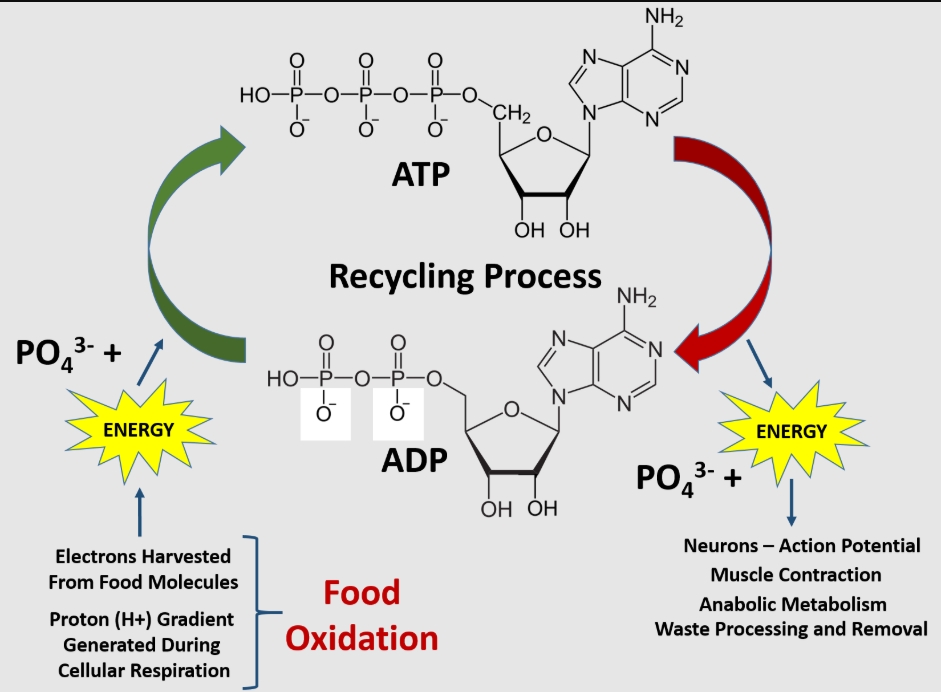
1. It provides energy for the cell to do work.
2. It composed of phosphate group, a ribose and adenine.
3. There are three group is attached to adenosine.
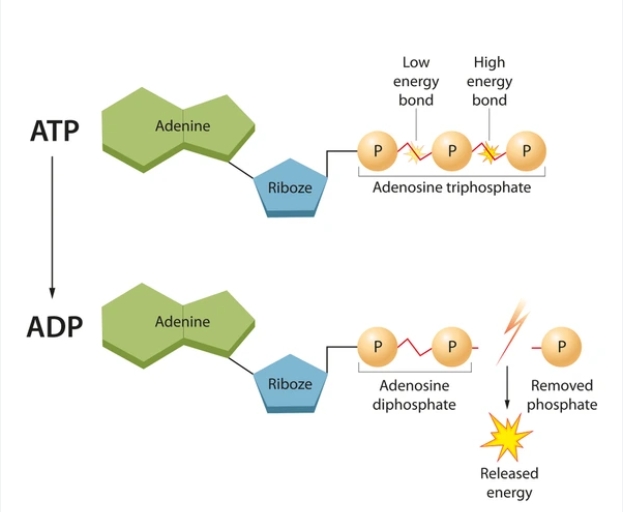
4. The last two bonds contain high energy that is useful for doing work within the cells.
5. The bonds that hold phosphate groups are easily broken by hydrolysis which results in the release of energy."
Structure of ATP
•ATP is a nucleotide that consists of three main structures: the nitrogenous base, adenine; the sugar, ribose; and a chain of three phosphate groups bound to ribose."
Chromatography a seperation technique used to identify various components of mixtures based on the differences in their structure and/composition.
Pigments allow plants to capture the sun's energy for photosynthesis by absorbing visible light. Since each pigment absorbs only a narrow range of wavelengths, plants produce multiple pigments of different colors to absorb more of the sun's energy. Different pigments absorb different wavelengths of light.
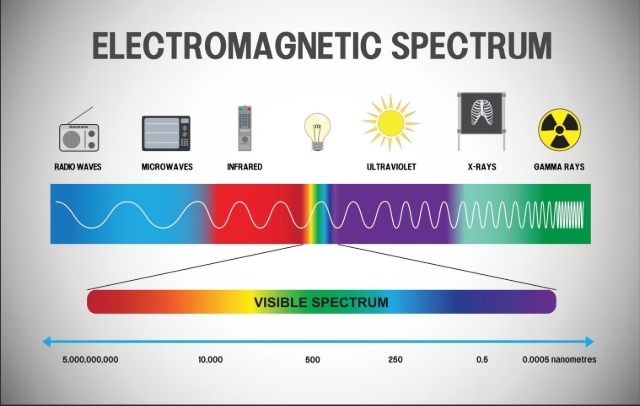
When light hits an object, it can be reflected, transmitted, or absorbed. Visible light (wavelengths 380-750 nm) is the part of the electromagnetic spectrum crucial to life and is perceived as different colors by the human eye. The color we see is the light that is not absorbed by the object's pigments but instead reflected or transmitted.
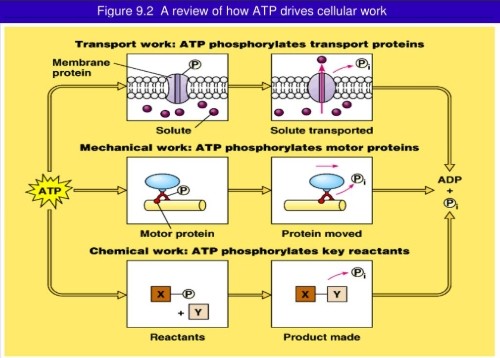
How the hydrolysis of atp perform work.
•Cells use ATP to perform work by coupling the exergonic reaction of ATP hydrolysis with endergonic reactions. ATP donates its phosphate group to another molecule via a process known as phosphorylation.
Phosphorylation
•The phosphorylated molecule is at a higher-energy state and is less stable than its unphosphorylated form, and this added energy from the addition of the phosphate allows the molecule to undergo its endergonic reaction.
Chlorophyll
A greenish pigment found in thylakoid membrane inside the chloroplast or a plant cell.
Chlorophyll absorbs blue and red light while it transmits and reflects green light. This is why leaves appear green."
Different kind of chlorophyll:
1.Chlorophyll a
2.Chlorophyll b
3.Chlorophyll c
4.Chlorophyll d
5.Chlorophyll e
6.Chlorophyll f
Among these, "chlorophyll a" plays the most important role in photosynthesis.
On the other hand, Other pigments in the chloroplast play the part of accessory pigments. These pigments can absorb light and transfer the energy to chlorophyll a.
Structure of chlorophyll
Head-a flat hydrophilic head called porphyrin ring. It has a magnesium atom at its center. Different chlorophylls differ on the side groups attached to the porphyrin.
Tail-a lipid-soluble hydrocarbon tail.
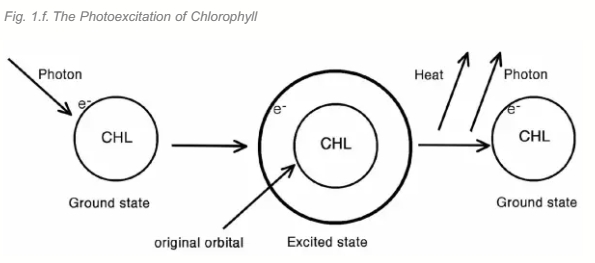
How does photoexcitation of chlorophyll happen?
1.A chlorophyll molecule absorbs photon or light energy.
2.An electron of the molecule in its normal orbital, said to be in its ground state, will be elevated to an orbital of a higher energy. The molecule is now in an excited state.
3.The excited state is unstable. Hence, excited electrons drop back down to the ground state immediately after, releasing energy in the form of heat and photon. This happens in isolated chlorophyll molecules."
A photosystem is a group of pigments and proteins in the thylakoid membrane responsible for absorbing photons and transferring energy and electrons.
Main Components:
1. Light-harvesting complex (Antenna complex):
•Contains multiple pigments (e.g., chlorophyll a, chlorophyll b, and carotenoids) bound to proteins.
•Captures photons and transfers energy from one pigment to another until it reaches the reaction center.
2. Reaction-center complex:
•Includes a pair of chlorophyll a molecules and a primary electron acceptor.
•The primary electron acceptor accepts electrons from chlorophyll a.
•Chlorophyll a molecules here are specialized to transfer electrons, not just raise energy levels.
Two Types of Photosystems:
1. Photosystem II (PSII):
•Discovered after Photosystem I but functions first in photosynthesis.
•Contains chlorophyll a known as P680, which absorbs light at 680 nm.
2. Photosystem I (PSI):
•Discovered first.
•Has chlorophyll a known as P700, absorbing light at 700 nm."