LESSON 2:PHOTOSYNTHESIS
Introduction
Autotrophic Organisms and Chlorophyll:
•Autotrophic organisms use chlorophyll to capture sunlight and convert it into chemical energy stored in ATP and carbohydrates.
•In eukaryotes, chlorophyll is found in the thylakoid membranes within chloroplasts.
Three Key Photosynthesis Processes in Eukaryotes:
1. Energy absorption from sunlight via pigments during light-dependent reaction.
2. Reaction Center Reactivation:
3. Carbohydrate production through carbon fixation during dark reaction.
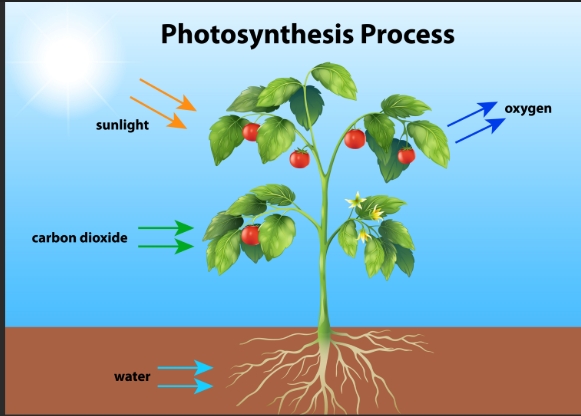
This image illustrates the process of photosynthesis, showing how plants convert carbon dioxide and water into glucose and oxygen using sunlight.
•Carbon dioxide (CO2)
•Water (H2O)
•Sunlight
•Products (Released Groups):
•Glucose (C6H12O6)
•Oxygen (O2)
Photosynthesis Equation:
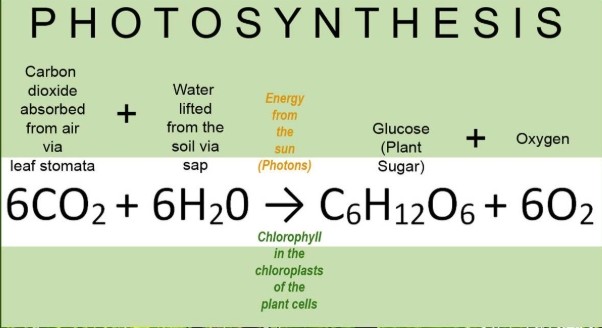
During Photosynthesis:
Energy from sunlight is captured and converted into chemical energy.
This energy is used to synthesize glucose (C6,H12,O6) from carbon dioxide (CO2 and water (H2O)).
Photosynthesis transforms sunlight into usable chemical energy, making it the primary source of energy, for nearly all living organisms.
In eukaryotic cells, both light and dark reactions happen in the chloroplast:
Light reactions in the thylakoid membrane.
Dark reactions in the stroma (fluid-filled area of the chloroplast).
The two stages of Photosynthesis:
1. Light reaction
•Occur in the thylakoid membranes of chloroplasts.
•Use sunlight to:
•Excite electrons, reducing NADP+ to NADPH.
•Split water (H2O) molecules, releasing oxygen (O2) as a by-product.
•Produce ATP through photophosphorylation.
•Products: ATP, NADPH,and O2.
2. Calvin Cycle (Dark Reactions):
•Occur in the stroma of the chloroplast.
•Do not require sunlight directly.
•Use ATP and NADPH (from the light reactions) to:
•Fix CO2 into organic molecules like glucose.
•Return ADP, inorganic phospate, and NADP+ back to the light reactions.
•Final product: Carbohydrates (like glucose).
Light Reaction Events
Calvin Cycle
•The Calvin Cycle is also known as the light-independent reactions or dark reactions of photosynthesis.
•It takes place in the stroma of the chloroplast.
•Its main purpose is to convert carbon dioxide (CO₂) into sugar using the energy from ATP and the reducing power of NADPH, both of which are produced during the light-dependent reactions.
•The sugar produced is G3P (glyceraldehyde-3-phosphate), a three-carbon molecule, not glucose directly.
•This process is a form of carbon fixation, where inorganic CO₂ is incorporated into organic molecules.
THREE PHASES OF CALVIN CYCLE:
(Carbon Fixation)
•Carbon fixation is the process of incorporating an inorganic carbon molecule, CO2, into an organic material.
•In this phase, the CO2 molecule is attached to a five-carbon sugar molecule named ribulose biphosphate (RuBP) aided by an enzyme named rubisco or RuBP carboxylase. Rubisco is believed to be the most abundant protein in the chloroplast and maybe on Earth.
•The resulting product, a six-carbon sugar, is extremely unstable and immediately splits in half. The split forms two molecules of a 3-phosphoglycerate (3-carbon).
In short, carbon fixation is the first step where plants grab CO2 and start making sugars.
REDUCTION
•ATP and NADPH are used to change 6 molecules of 3-PGA into 6 molecules of glyceraldehyde 3-phosphate (G3P).
•3-PGA gets energy from ATP to form 1,3-bisphosphoglycerate, making ADP.
•NADPH gives up energy and a hydrogen atom, becoming NADP+.
•The result is glyceraldehyde-3-phosphate (G3P), glucose with ADP and NADP+.
•ADP and NADP+ go back to the light-dependent reactions to be reused.
To form three molecules of RuBP we need Five molecules of G3P undergo a series of complex enzymatic reactions.
This deduct three molecules of AT in the cell, but provides another set of RuBP to continue the cycle.
What happens to G3P after its release from the cycle?